
 News
News
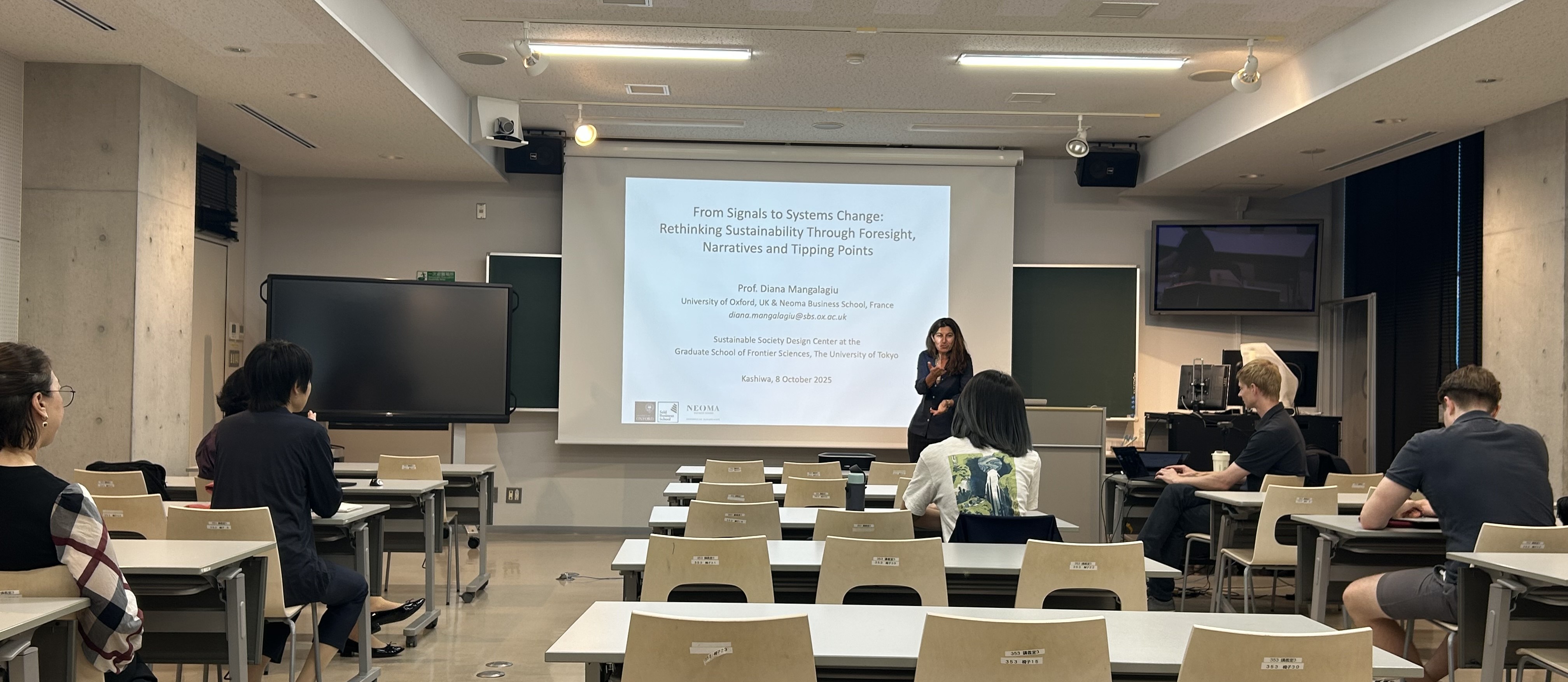
From Signals to Systems Change: Rethinking Sustainability Through Foresight, Narratives and Tipping Points
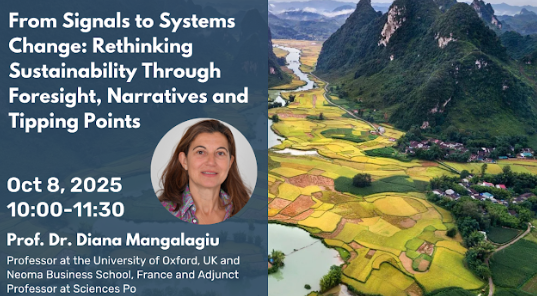
Speaker: Professor Diana Mangalagiu (University of Oxford / Neoma Business School / Sciences Po)
Moderator: Project Lecturer Giles B. Sioen (Sustainable Society Design Center, Graduate School of Frontier Sciences, The University of Tokyo)
Oct 8th, 2025
In this thought-provoking seminar, Professor Diana Mangalagiu explored what it takes to accelerate sustainability transitions in today’s fragmented and fast-changing world. Drawing on over two decades of interdisciplinary research and strategic advisory work—from artificial intelligence and foresight methodologies to global environmental governance—she shared insights from a range of international initiatives that have shaped her own evolution as a scientist and systems thinker.
Highlighting projects such as TIPPING+ (regional tipping points for just decarbonisation), the IPBES Nexus Assessment (biodiversity–climate–food governance), GREEN-WIN (transformative narratives in climate action), and UNEP/ISC foresight work on planetary health, Professor Mangalagiu demonstrated how narratives, coalitions, and weak signals of change can catalyze systemic transformation.
A key theme was the interplay between material systems, socio-economic relationships, and knowledge systems—and how recognizing “positive tipping points” can empower policy innovation and collective leadership. Drawing from experiences with organizations such as UNICEF and the European Space Agency, she illustrated how foresight and scenario approaches help institutions engage with uncertainty, identify emerging trends, and co-create governance roadmaps for sustainability transitions.
Professor Mangalagiu also reflected on her personal journey—from Romania’s dictatorship years to a Ph.D. in Artificial Intelligence to becoming a leading voice in global sustainability foresight. Her talk underscored the ethical dimensions of technological progress, the importance of integrative and strategic mindsets, and the need to bridge disciplines, sectors, and cultures to drive real-world change.
“The future is always fiction, and the path is never clear,” she concluded, “but by learning to see signals of change and act collectively, we can turn small insights into systemic transformation.”
Faculty and students engaged in discussions after the seminar, reflecting on the role of sustainability science and applying the insights from the seminar to their own research.